My son is a rising senior interested in computer science. The University of Alabama is on his list as a possible financial safety. They publish automatic merit scholarship tiers, which can make the out-of-state cost much more predictable for families who qualify. We had been talking about visiting campus this summer.
I was not trying to test AI. I was just trying to solve a very normal rising-senior parent problem: how do we make a long drive actually useful?
So I did what a lot of parents would do. I asked AI for help planning the trip.
But I asked two different tools. First ChatGPT. Then Scout, CollegeHound's built-in college planning AI.
The difference was not subtle.
The Experiment
The prompt was simple: If we went to visit Alabama, what would be good colleges to visit from Raleigh to Tuscaloosa?
Same question. Same family. Two very different answers.
You're on the list.
Watch for planning tips matched to where your student is right now.
Step 1: I Asked ChatGPT
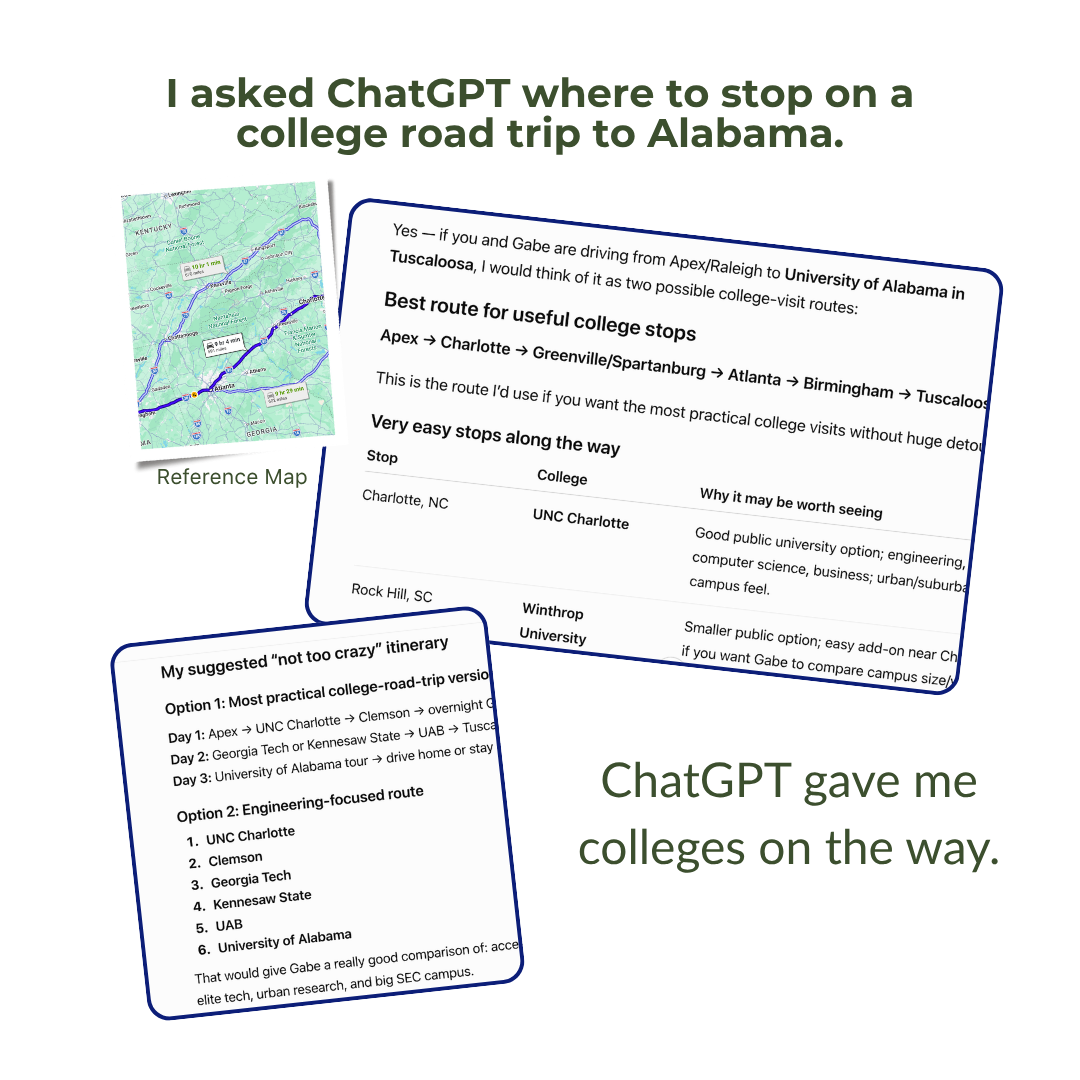
ChatGPT answered the question literally. It gave me colleges along the I-85 corridor: UNC Charlotte, Winthrop, USC Upstate, Kennesaw State, Georgia State, Furman, Wofford.
These are fine schools. But none of them are on my son's list. None of them match his profile. ChatGPT does not know that he is interested in computer science, what his test scores look like, or that he has already visited Virginia Tech and loved the campus feel.
It gave me colleges that happen to be on the way. That is not the same as colleges that are worth visiting.
To be fair, ChatGPT did include Clemson and Georgia Tech in its list. But they were buried alongside schools like Wofford and Kennesaw State with no explanation of why one would matter more than another for my family. Every school got equal weight because ChatGPT has no context for what "fit" means for my student.
Step 2: I Asked Scout
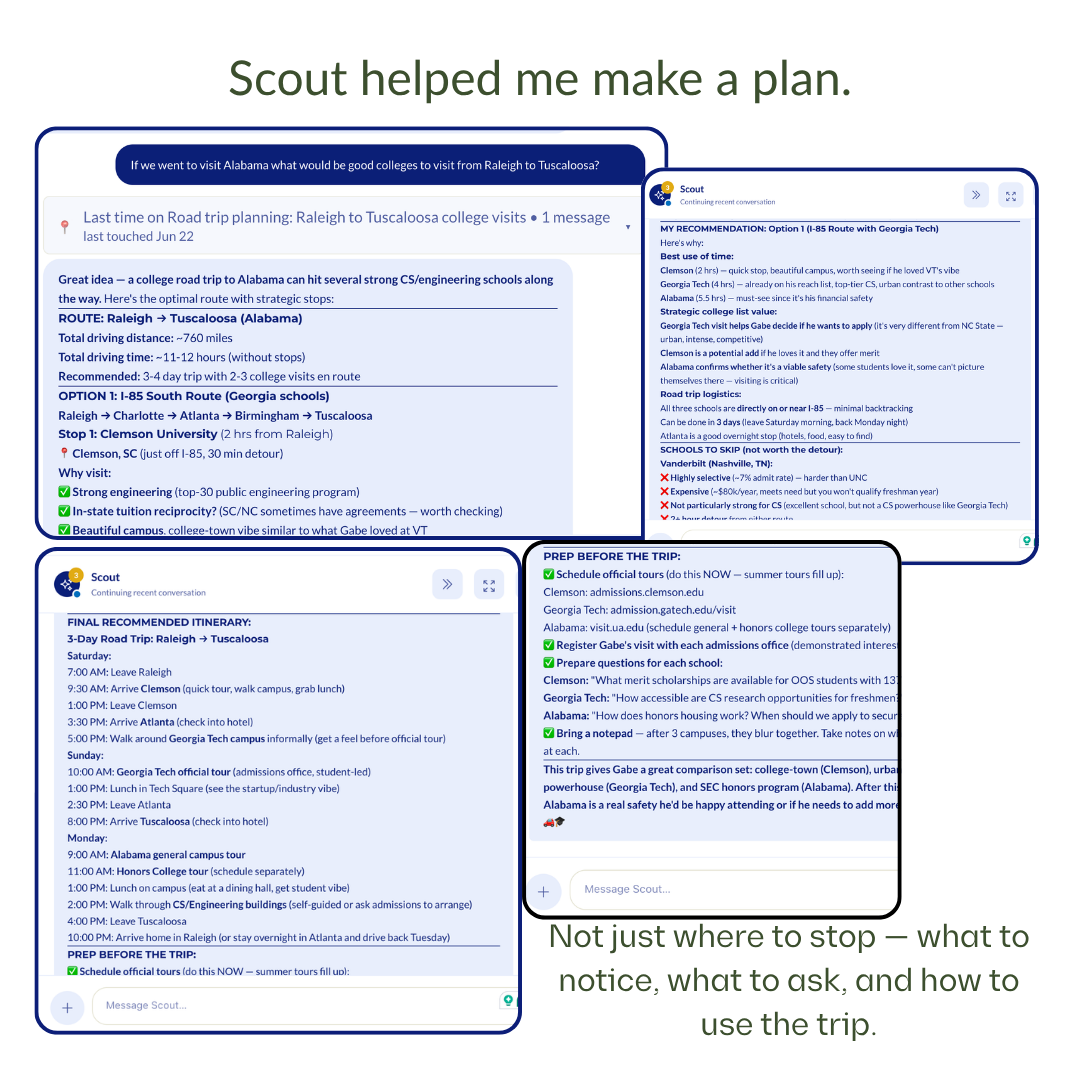
Scout uses the information we have added to CollegeHound: his college list, academic profile, interests, and the campuses he has already visited.
So when I asked the same question, Scout did not just give me a list of colleges on a map. It gave me a plan.
Here is what Scout recommended:
Stop 1: Clemson University, two hours from Raleigh, just off I-85. Scout flagged it because the campus has a similar college-town feel to Virginia Tech, which my son loved. It noted the strong engineering program and mentioned that out-of-state cost would need merit aid to work.
Stop 2: Georgia Tech, already on my son's reach list. Scout recommended using the visit to see what a top-tier urban CS program actually looks and feels like, since it is a completely different environment from the other schools on his list. It also suggested specific questions to ask about freshman research access.
Stop 3: University of Alabama, the destination. Scout recommended scheduling the general campus tour, the Honors College tour, and a CS department walk-through separately. It also flagged that housing timelines matter, because earlier housing applicants generally get earlier room selection times, and specific building choices are not guaranteed.
Then Scout built a three-day itinerary:
- Saturday: Leave Raleigh at 7am. Tour Clemson mid-morning. Drive to Atlanta. Walk Georgia Tech's campus informally that evening.
- Sunday: Official Georgia Tech tour. Lunch in Tech Square. Drive to Tuscaloosa.
- Monday: Full day at Alabama: general tour, Honors College, CS buildings, eat in a dining hall. Drive home that evening or stay one more night.
Scout also told me which schools to skip and why. Vanderbilt: too selective for a realistic target, expensive, and a two-hour detour. Emory: no engineering program. Duke: only an hour from home, visit separately.
And it gave me a prep checklist: schedule tours now because summer slots fill fast, register visits through the admissions office when possible, and prepare specific questions for each stop. Some colleges track demonstrated interest, and even when they do not, registering helps families stay organized and ensures they get the right tour information.
Meet Scout
Why the Difference Matters
ChatGPT answered a geography question - What colleges are between Raleigh and Tuscaloosa?
Scout answered the question I was actually asking - Which colleges should my son visit on this trip, and how should we plan it?
The difference comes down to context. ChatGPT does not know my family. It does not know what schools are on my son's list, what he is looking for in a campus, or what our budget looks like. So it does the only thing it can. It gives a generic answer that would apply to any student driving that route.
Scout has all of that context. It knows every school on the college list. It knows test scores and GPA. It knows which campuses have already been visited. So when it recommends Clemson, it is not because Clemson is near the highway. It is because Clemson matches a specific set of criteria that matter to this student.
That is the difference between information and advice.
What Families Should Take From This
I am not saying ChatGPT is bad. It is genuinely useful for quick questions. But college planning is personal. Every family has different schools, different budgets, different priorities, and different students.
A tool that does not know your student can only give you a starting point. A tool that knows your student can give you a plan.
If your family is planning college visits this summer, here is what I would suggest:
- Focus on three to four schools per trip. After that, campuses blur together. Pick schools that represent different categories (a reach, a target, and a safety) so your student can compare real experiences.
- Book tours now. Summer slots at popular schools fill up fast, especially for rising seniors. Do not wait until July.
- Register your visit. Some schools track demonstrated interest, and even when they do not, registering through the admissions office helps you get the right tour information and stay organized.
- Take notes after each campus. Write down what your student liked and did not like while it is fresh. Two weeks later, they will not remember which school had the impressive engineering lab and which one had the dining hall that felt like a cafeteria. CollegeHound has a Visits section built into each college in your student's list. Use it to capture notes, photos, and impressions in one place so you can compare later.
- Ask strategic questions. Do not just take the standard tour. Ask about merit scholarships for out-of-state students, research access for freshmen, and honors housing timelines. Not sure what to ask? Scout can generate campus-specific questions based on your student's profile and goals before you even get in the car.
CollegeHound's Scout helped us turn a road trip into a strategy. That is what personalized AI can do when it actually knows your student.
Meet Scout
See how Scout gives personalized college planning advice based on your student's actual profile.
You're on the list.
Watch for planning tips matched to where your student is right now.